




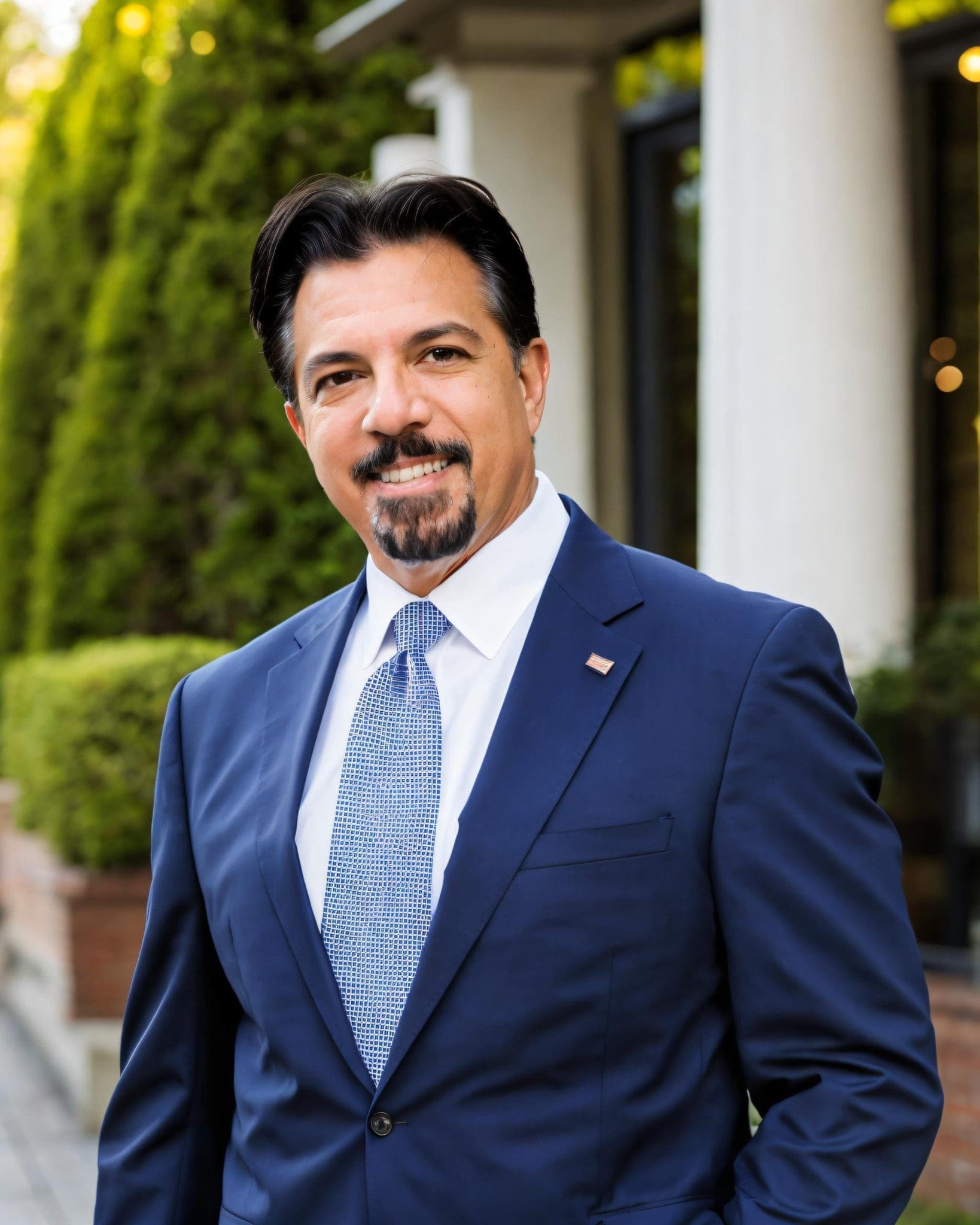
For many of us, AI felt like the future arrived overnight. But for Carmen “Carm” Taglienti, Ed.D., it’s simply the field he’s been working in for decades—long before ChatGPT became a household name.
-

Carm Taglienti - Carm is the Chief Technology Officer, Public Sector, for Insight Enterprises, a Fortune 500 solutions integrator helping organizations accelerate their digital journey. Now, he brings his expertise to the role of academic director for the new online Master of AI Strategy and Innovation program at Wake Forest School of Professional Studies (SPS).

Carm’s decades-long career in the field makes him uniquely qualified to help students prepare for future careers in a fast-moving industry.
“Sometimes people say, ‘Oh, I thought AI was 2 years old,’ but I’ve been doing this work for 30 years,” he said.
After earning his bachelor’s in computer science, Carm began his career in a highly technical programming role with the aerospace leader Raytheon in the mid-80s. There, he found real use cases for machine learning algorithms in satellite communications and missile guidance systems. From there, Carm progressed to advanced simulation, where he was immersed in innovations that laid the groundwork for AI as we know it today.
“I was using advanced computer graphics, simulating smoke, fractal shadowing, and other interesting applications of what are called machine learning applications today,” he explained. “They were used to help you understand and predict the physical, real-world space. These are the technologies used now in automated driving systems.”
While it would be decades before AI was ready for consumers, Carm wanted to expand his capabilities as a technologist. He went on to earn his master’s degree in systems engineering from Boston University. He progressed into managerial and consulting roles, where he helped businesses reimagine their processes with the latest tech. In the late 2000s, Carm served as technology architect at Microsoft with a focus on business intelligence and large-scale database infrastructure, and he served in a similar capacity at TripAdvisor.
Today, Carm remains a leader in the field, but he felt pulled to give back to the learning community. His first introduction to teaching was ten years ago at Merrimack College, a small university in North Andover, Massachusetts. It sparked his love for teaching and eventually led him back to school to pursue a doctorate in education from Northeastern University.
In that time, AI has come full circle. But Carm’s experience gives him a realistic view of the technology and where it is headed.
“People shouldn’t be afraid of AI,” he said. “It’s not a new phenomenon. It’s an evolution of access to massive data, faster processing, higher capacity networking, and ubiquitous multi-modal interactivity, and it’s up to us to know how to apply this technology successfully and ethically.”
Carm’s goal with the AI Strategy and Innovation program is to prepare students for this reality: That coding is not the only skill they need. They also need to understand the application. He wants students to be less focused on the tools themselves and more focused on how they align to business objectives and expectations.
“We want to understand applicability,” Carm said. “How do we use AI within the business arena? What is important to know and what skills do we need to adapt moving forward? That’s the focus we want to take.”
To that end, Carm expects the AI program to be nimble all while helping students spot the patterns they need to deploy AI effectively.
“Wake Forest SPS uses a very modular design,” Carm said. “If there’s a piece of curriculum that I need to update, I can easily update it. That’s an important part of keeping up with technology because it’s changing so fast.”
AI has been around for years, but Carm feels like the technology is just getting started. He believes adaptability will prove critical in a constantly changing environment. But for him, alongside the ability to pivot is also the responsibility to apply AI ethically.
“My philosophy is to focus on using AI as a human learning tool and as a way to augment our own human capabilities, not replace them,” he said.
“I do not like the path of using AI as a weapon. I believe we need to take a more humanistic approach, and if we continue to work toward that, I have faith we will figure it out eventually.”
Learn more about the AI Strategy and Innovation master’s program. Request information today.