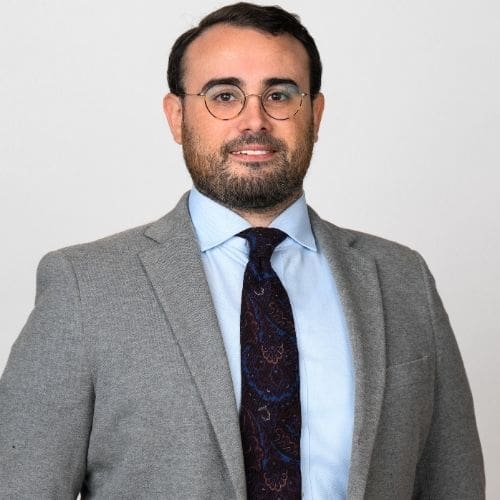
Author: Rollins Luckey, Wake Forest SPS student and President of PAYETHOS
The payments industry is constantly evolving. New tools, platforms, and architectures appear with regularity, each promising to redefine how money moves. Yet much of the infrastructure supporting merchant acquiring and embedded payments still reflects legacy assumptions. Static underwriting, fragmented data, opaque decisioning, and manual oversight remain common.
As President and Co-Founder of PAYETHOS, a next-generation wholesale ISO and embedded payments platform, my work lives in the space between what technology makes possible and what regulated financial systems can responsibly support. That tension is what led me back to graduate school after nearly 20 years in financial services, and specifically to the Master of Financial Technology and Analytics (MFTA) program at Wake Forest School of Professional Studies (SPS).
Professor Ivan Bakrac’s FTA 722 Emerging Technologies course has been particularly influential because it does not approach innovation as an abstract exercise. Instead, it provides a disciplined way to evaluate how emerging technologies actually change operating decisions inside real financial institutions.
FTA 722 moves quickly beyond buzzwords. Artificial intelligence, generative AI, Web3 and blockchain, cloud and decentralized infrastructure, immersive technologies, and edge computing are examined not for novelty but for their impact on governance, risk, scalability, and trust. A recurring theme throughout the course is that technologies do not create value on their own. They create value only when they are integrated into full systems that align incentives, controls, and human judgment.
That perspective has directly shaped how I think about building PAYETHOS. In merchant acquiring, risk is often assessed at discrete points in time, most notably during onboarding. The course challenged that model by exploring how machine learning, IoT-enabled devices, and edge computing can support continuous risk assessment. Rather than relying solely on static profiles, systems can evaluate merchant behavior, transaction flows, and device telemetry in near real time. For PAYETHOS, this makes risk management dynamic, transparent, and responsive, rather than reactive.
Another critical takeaway from FTA 722 is the clear distinction between data privacy, information security, and cybersecurity. These concepts are frequently conflated in industry discussions, yet they address fundamentally different problems. Privacy focuses on purpose limitation and appropriate data use. Information security focuses on protecting sensitive information from unauthorized access. Cybersecurity addresses the broader protection of systems and networks from attack. Understanding these distinctions is essential when designing platforms that use AI and data at scale. At PAYETHOS, this has informed decisions around data minimization, access controls, and how generative AI is used to support, rather than replace, human decision making.
At a structural level, this approach has led us to think explicitly about model context as an actionable layer, not an incidental input. Rather than allowing generative models to operate on broad or ambiguous information, PAYETHOS is being designed so each interaction is scoped to a defined context that reflects the user’s role, permissions, and the specific decision at hand. An underwriter, a merchant, and a sponsor bank reviewer should not see or receive the same information, even when asking similar questions. By treating context as an intentional protocol rather than an ad hoc prompt, generative AI becomes more predictable, more auditable, and better aligned with regulatory expectations in financial services.
The course’s treatment of Web3 and blockchain was similarly pragmatic. Rather than positioning blockchain as a universal solution, FTA 722 examined targeted use cases where its properties are genuinely useful. In payments, one persistent challenge is fragmented merchant identity and compliance history across institutions. Permissioned blockchain structures can help anchor key lifecycle events in a tamper-resistant way without exposing sensitive data. That framing has influenced how I think about auditability, shared trust, and long-term interoperability between sponsor banks, processors, and platforms.
What makes Professor Bakrac’s teaching particularly effective is his insistence on connecting emerging technologies back to institutional realities. Regulatory expectations, model governance, ethical considerations, and human oversight are treated as design inputs rather than obstacles. That approach mirrors the reality fintech operators face. Innovation succeeds only when it strengthens trust across all stakeholders, including merchants, banks, partners, and regulators.
More broadly, the MFTA program has reinforced an important lesson. Emerging technologies are not about chasing novelty or disruption for its own sake. They are about improving decision quality, transparency, and resilience in complex systems. For merchants and partners evaluating PAYETHOS, that philosophy matters. It shapes how we think about onboarding, pricing, risk, compliance, and long-term partnership.
For me, returning to graduate study has been more than an academic exercise. I am using the frameworks developed in FTA 722 to actively shape how PAYETHOS is being built today. They help ensure that the technologies we adopt are not only advanced, but also responsible, explainable, and aligned with the realities of operating in a highly regulated financial environment. That is what ultimately turns emerging technology into durable infrastructure.