



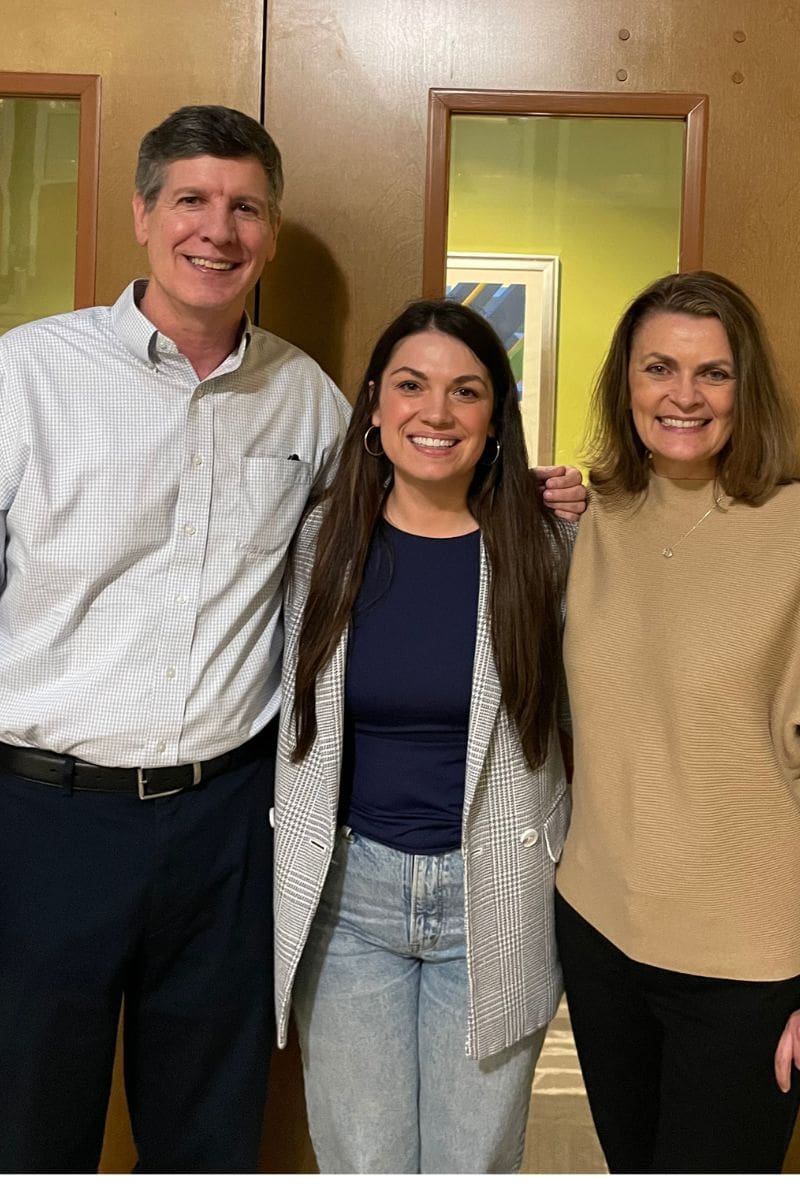
Victoria Little is a natural connector.
“I love getting people together whether it’s professionally or personally and making connections,” Victoria said. “I’m curious. I’ve always been interested in people, what they do, and how we can help each other.”
This natural curiosity to learn more about people and how to help them led her to pursue a B.S. Communication from Appalachian State University. Today, she is furthering her education and fueling her curiosity about how people operate with a Master of Communications degree from Wake Forest School of Professional Studies.
Living near Winston-Salem, Victoria knew the Wake Forest University reputation well. She began searching for a graduate program that would fit her schedule as a full-time caregiver for her young son. When she came across the program at Wake Forest SPS and saw the flexible structure, she knew it was the right fit.
The online, asynchronous format is what attracted Victoria to the program, but she still felt compelled to engage with Wake Forest community in-person whenever possible.
“I like to take advantage of any face-to-face opportunities or extracurricular activities. Since I live so close to the Winston-Salem campus, it’s easier to feel connected there,” she explained.
The Master of Communications program is 100% virtual, but Victoria knew that taking the time to build community would make the program more beneficial. Forming these connections with other students as well as the faculty and staff at Wake Forest SPS amplifies the overall experience and supports her academic success. To do that, Victoria made it a priority to engage with the community whenever possible.
“Connecting with my peers outside of coursework through texts and group chats has been really amazing,” she said. “Sure, it’s an online program but that doesn’t mean there aren’t opportunities to get to know one another.”
One of those opportunities presented itself in October at Wake360, an annual weekend-long, in-person event that brings the Wake Forest SPS community together to learn, connect, and network. At Wake360, Victoria had the opportunity to hear from industry leaders on relevant topics as well as network with students from all programs.
“I was on fire after Wake360,” she recalled. “I couldn’t wait to get more involved and take advantage of what the university has to offer.”
That fire led her to say “yes” to another extracurricular activity that caught her eye – the 2024 Mental Health Rewired event hosted by the Wake Forest Center for Remote Health Monitoring and the Wake Forest Center for Artificial Intelligence Research. This event challenged teams to work together to develop digital solutions aimed at advancing mental health support.
“Mental health is often stigmatized or overlooked,” Victoria explained. “The opportunity to contribute to a solution that combines technology and empathy felt incredibly meaningful.”
Her team was made up of two other graduate students from different disciplines, including pre-med and health informatics. Together, they combined their unique knowledge and skillsets to develop Team Trifecta.
According to Victoria it was their diverse backgrounds and perspectives on the team that played a key role in the success: “Our team brought together students from communications, computer science, psychology, and public health. This multidisciplinary approach allowed us to think holistically about the user experience and the technical feasibility of our product.”
Team Trifecta met regularly via Zoom for the next three weeks to develop their solution – TheraVoyage, a virtual reality platform geared toward supporting autistic children who might have a hard time communicating with mental health professionals in an in-person, clinical setting. Victoria brought her communications expertise to the table and helped craft the compelling narrative around TheraVoyage, what it is, and why it matters.
They presented their solution on November 19th to medical researchers and doctors affiliated with the Wake Forest University School of Medicine. The panel of judges deliberated before announcing that Team Trifecta won first place in Track 2: Digital Mental Health Product Invention.
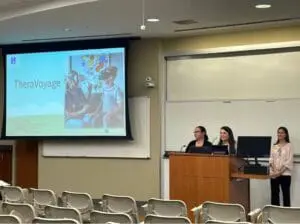
“For a second, I thought they had misspoken,” Victoria joked. “We sat there a moment before realizing they were announcing our team’s name and that we had one. I just couldn’t believe it.”
This experience is testament to the power of collaboration and the importance of addressing mental health challenges through innovation.
For Victoria, it was also an opportunity to challenge herself: “Competitions like this are a chance to step out of your comfort zone and tackle complex problems with a team.”
Learn more about our online Master of Communications program today.